












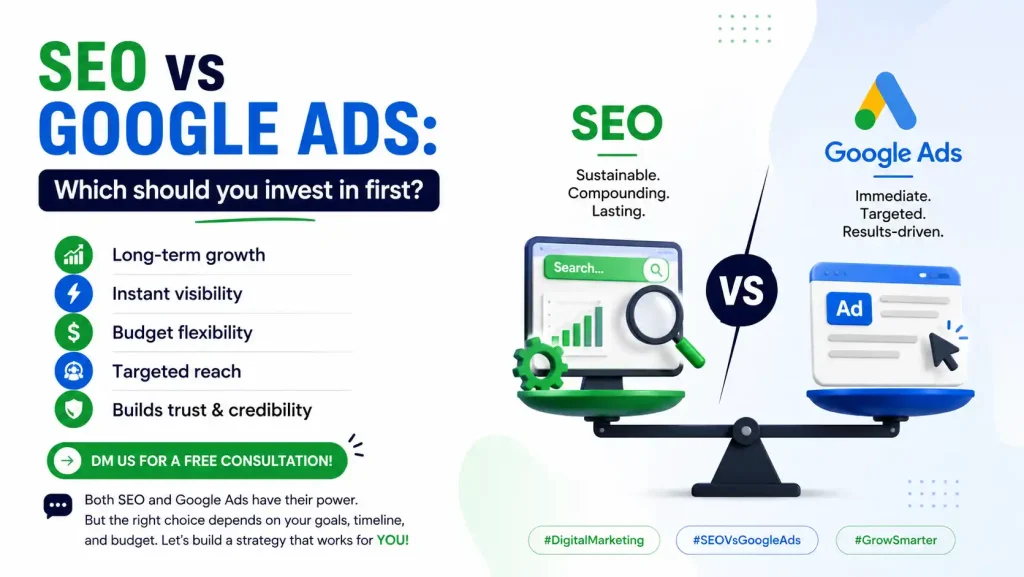
SEO vs Google Ads: Which Should You Invest in First?
Introduction
You’ve launched your business website, and now comes the million-dollar question: Should you invest in SEO or jump straight into Google Ads?
This isn’t just a marketing debate—it’s a decision that can make or break your digital presence. Choose wrong, and you’ll burn through your budget with little to show. Choose right, and you’ll build a sustainable growth engine for years to come.
The truth? There’s no one-size-fits-all answer. But by the end of this guide, you’ll know exactly which strategy fits your business goals, budget, and timeline.
Let’s dive deep into the SEO vs Google Ads battle and help you make the smartest investment decision for your business.
What is SEO? (Search Engine Optimization)
Search Engine Optimization is the practice of optimizing your website to rank higher in organic (unpaid) search results on Google and other search engines.
How SEO Works
When someone searches for “best running shoes for beginners,” Google’s algorithm scans billions of web pages to show the most relevant, high-quality results. SEO helps your website become one of those top results.
Key Components of SEO:
On-Page SEO: This involves optimizing individual web pages with target keywords, compelling meta descriptions, header tags, internal linking, and high-quality content that answers user queries.
Off-Page SEO: Building your website’s authority through backlinks from reputable sites, brand mentions, social signals, and online reputation management.
Technical SEO: Ensuring your website loads fast, is mobile-friendly, has proper site architecture, uses HTTPS security, and is easily crawlable by search engine bots.
Content Marketing: Creating valuable blog posts, guides, videos, and resources that attract and engage your target audience while naturally incorporating relevant keywords.
SEO Timeline: When Will You See Results?
This is where SEO tests your patience. Unlike paid ads that deliver instant traffic, SEO is a long-term investment:
- Months 1-3: Foundation building—keyword research, content creation, technical fixes, initial rankings for low-competition terms
- Months 4-6: Gradual traffic increase, ranking improvements for medium-competition keywords, authority building
- Months 7-12: Significant traffic growth, rankings for competitive keywords, compounding returns
- Year 2+: Exponential growth, market dominance for your niche, sustainable passive traffic
Most businesses start seeing meaningful results within 6-12 months, though competitive industries may take longer.
What are Google Ads? (Pay-Per-Click Advertising)
Google Ads is Google’s advertising platform where businesses pay to display ads at the top of search results, on YouTube, across millions of websites, and in Gmail.
How Google Ads Work
You bid on keywords relevant to your business. When someone searches for those keywords, your ad may appear. You only pay when someone clicks your ad (Pay-Per-Click or PPC model).
Types of Google Ads Campaigns:
Search Ads: Text ads that appear at the top and bottom of Google search results, targeting users actively searching for your products or services.
Display Ads: Visual banner ads shown across Google’s Display Network of over 2 million websites and apps, perfect for brand awareness.
Shopping Ads: Product-based ads showing images, prices, and reviews, ideal for e-commerce businesses selling physical products.
Video Ads: Advertisements on YouTube and video partner sites, great for storytelling and engaging visual content.
Performance Max: AI-powered campaigns that automatically optimize across all Google channels for maximum conversions.
Google Ads Timeline: When Will You See Results?
The beauty of Google Ads is immediacy:
- Day 1: Your ads can be live and generating traffic within hours of campaign setup
- Week 1: Initial data collection, understanding click-through rates and conversion patterns
- Weeks 2-4: Optimization phase—refining targeting, ad copy, and bidding strategies
- Month 2+: Mature campaigns with predictable ROI and optimized performance
However, the moment you stop paying, your traffic disappears entirely.
SEO vs Google Ads: Head-to-Head Comparison
Cost Comparison
SEO Investment:
- Initial setup: $500-$5,000+ (depending on site size and complexity)
- Ongoing monthly cost: $500-$10,000+ for professional services
- Content creation: $100-$500 per article for quality content
- Long-term cost-per-click: Approaches $0 as you rank organically
- ROI timeframe: 6-12 months to see positive returns
Google Ads Investment:
- Setup cost: $500-$2,000 for professional campaign setup
- Monthly ad spend: Highly variable—$500 to $50,000+ depending on industry and goals
- Average CPC: $1-$50+ per click (competitive industries like legal, insurance, and finance can exceed $100 per click)
- ROI timeframe: Immediate, but requires continuous spending
- Total cost: Can quickly exceed $10,000-$50,000 annually for competitive markets
Winner: SEO wins for long-term cost efficiency, Google Ads wins for predictable budgeting.
Speed of Results
SEO: Slow burn. Expect 3-6 months before seeing significant traffic, 6-12 months for competitive keyword rankings.
Google Ads: Instant gratification. Launch campaigns in the morning, get traffic by afternoon.
Winner: Google Ads dominates for immediate results.
Sustainability
SEO: Once you rank, you continue receiving traffic without paying for each click. Rankings can persist for years with proper maintenance.
Google Ads: Traffic stops the second you pause campaigns. Zero sustainability without ongoing investment.
Winner: SEO provides long-term, sustainable traffic.
Click-Through Rates
SEO organic results: Top 3 organic results capture 54.4% of all clicks. Position 1 averages 27.6% CTR.
Google Ads: Paid search ads capture approximately 2-5% of total clicks, with most users scrolling past ads to organic results.
Winner: SEO generates significantly higher click-through rates.
Trust and Credibility
SEO: Users trust organic results more. 70% of search users prefer clicking organic links over ads.
Google Ads: Clearly marked as “Sponsored” or “Ad,” which some users perceive as less trustworthy or overly promotional.
Winner: SEO builds more brand trust and authority.
Targeting Capabilities
SEO: Limited targeting—you optimize for keywords and topics, but can’t control who specifically sees your content.
Google Ads: Granular targeting by location, demographics, device, time of day, income level, interests, and remarketing to previous visitors.
Winner: Google Ads offers superior targeting precision.
Conversion Rates
SEO organic traffic: Average conversion rate: 2-5% (higher for informational content, varies by industry)
Google Ads: Average conversion rate: 3-7% (can be higher for bottom-funnel, high-intent keywords)
Winner: Slight edge to Google Ads for immediate conversions, but SEO builds longer-term customer relationships.
When Should You Choose SEO First?
SEO should be your primary investment if:
You Have a Limited Budget: If you can’t afford $1,000+ monthly ad spend, invest that money in content and SEO foundation. The returns compound over time.
You’re Playing the Long Game: Building a sustainable business over 3-5 years? SEO creates an asset that appreciates. Your rankings and authority grow stronger over time.
You’re in a Low-Urgency Industry: Selling products or services with longer research cycles (B2B software, luxury items, education) where buyers take weeks or months to decide.
You Have Great Content to Offer: If you can create valuable blog posts, guides, videos, or tools that genuinely help your audience, SEO amplifies that content.
You Want to Build Brand Authority: Ranking #1 for important keywords positions you as the industry leader, which paid ads can’t replicate.
Your Market Has Reasonable Competition: In less saturated niches, you can rank relatively quickly without massive budgets.
Examples of SEO-First Businesses:
- Bloggers and content creators
- Local service businesses (plumbers, dentists, lawyers in smaller markets)
- B2B companies with niche solutions
- Startups building brand recognition
- E-commerce stores with unique products
When Should You Choose Google Ads First?
Google Ads should be your priority if:
You Need Immediate Sales: Launching a new product? Running a seasonal promotion? Can’t wait 6 months for SEO? Google Ads delivers instant traffic and revenue.
You Have Sufficient Marketing Budget: If you can comfortably invest $2,000-$5,000+ monthly without sweating, Google Ads can provide predictable, scalable results.
You’re Testing Market Demand: Before investing heavily in SEO for a new product or service, validate demand with Google Ads. Get quick feedback on messaging, pricing, and audience fit.
You’re in a Hyper-Competitive Industry: In industries where organic rankings are dominated by giants with massive SEO budgets (insurance, legal, finance), Google Ads might be your only way to compete initially.
You Have a High Customer Lifetime Value: If each customer is worth $1,000-$10,000+, you can afford higher CPCs and still maintain healthy ROI.
You’re Targeting Bottom-Funnel Keywords: When users search “buy,” “best price,” “near me,” or other high-intent terms, Google Ads captures them at the perfect moment.
You Need Precise Targeting: Launching in specific cities? Targeting particular age groups or income levels? Google Ads’ targeting capabilities are unmatched.
Examples of Google Ads-First Businesses:
- E-commerce stores with proven products
- Local service businesses in competitive markets
- Event-based businesses (wedding planners, catering)
- High-ticket B2B services
- Businesses with time-sensitive offers
The Smart Strategy: Why Not Both?
Here’s what successful businesses know: SEO vs Google Ads isn’t an either-or decision—it’s about strategic allocation and timing.
The Integrated Approach
Phase 1 (Months 1-3): Google Ads for Immediate Revenue + SEO Foundation
- Launch Google Ads campaigns to generate immediate traffic and sales
- Use ad revenue to fund SEO investments
- Begin keyword research, technical SEO fixes, and content strategy
- Use Google Ads data to identify high-converting keywords for SEO targeting
Phase 2 (Months 4-9): Balance Investment as SEO Gains Traction
- Continue Google Ads but refine based on performance data
- Ramp up content production and link building
- Start seeing initial SEO traffic and rankings
- Reduce Google Ads spend on keywords where you’re ranking organically
Phase 3 (Months 10+): SEO-Dominant with Strategic Google Ads
- Significant organic traffic reduces dependency on paid ads
- Use Google Ads strategically for competitive keywords, promotions, or new products
- Enjoy compounding SEO returns while maintaining paid presence where it matters
Using Google Ads Data to Supercharge SEO
This is the secret weapon most businesses miss:
Keyword Performance: See which keywords convert best in Google Ads, then prioritize those for SEO content.
Ad Copy Testing: Test headlines and descriptions in Google Ads, then use the winners for meta titles and descriptions.
Landing Page Optimization: Optimize conversion rates on paid landing pages, then apply those insights to organic pages.
Audience Insights: Discover which demographics and interests convert, then create content targeting those audiences.
Budget Allocation Framework
Tight Budget ($500-$1,500/month):
- 70% SEO (content, technical fixes, basic link building)
- 30% Google Ads (small campaigns for high-intent keywords)
Medium Budget ($1,500-$5,000/month):
- 60% SEO (comprehensive strategy, quality content, outreach)
- 40% Google Ads (multiple campaigns, testing, retargeting)
Healthy Budget ($5,000-$15,000+/month):
- 50% SEO (aggressive content, competitive link building, authority building)
- 50% Google Ads (full-funnel campaigns, brand protection, market domination)
Established Business with Strong SEO:
- 70-80% SEO (maintenance, expansion, authority building)
- 20-30% Google Ads (strategic, competitive, promotional)
Common Mistakes to Avoid
SEO Mistakes That Kill Results
Keyword Stuffing: Overusing keywords unnaturally. Google’s algorithms detect this and penalize your rankings. Write for humans first, optimize for search engines second.
Ignoring User Intent: Ranking for keywords that don’t match what you offer leads to high bounce rates and poor conversions.
Neglecting Technical SEO: Slow sites, broken links, poor mobile experience, and crawl errors sabotage your rankings no matter how good your content is.
Buying Backlinks: Purchasing low-quality links from link farms or PBNs can result in manual penalties that destroy your rankings overnight.
Thin Content: Publishing short, low-value articles just to have content hurts more than helps. Aim for comprehensive, valuable resources.
Expecting Overnight Success: SEO takes time. Abandoning your strategy after 2-3 months means wasting your investment.
Google Ads Mistakes That Waste Money
Poor Keyword Match Types: Using broad match without negative keywords drains budgets on irrelevant clicks.
Sending Traffic to Your Homepage: Generic landing pages convert poorly. Create specific landing pages for each ad group.
Not Using Negative Keywords: Exclude irrelevant searches to avoid wasting ad spend on clicks that will never convert.
Ignoring Quality Score: Low Quality Scores mean higher CPCs. Improve ad relevance, landing page experience, and CTR to lower costs.
Set and Forget Mentality: Google Ads requires constant monitoring, testing, and optimization. Neglected campaigns bleed money.
No Conversion Tracking: If you don’t know which keywords and ads drive sales, you’re flying blind and wasting budget.
The Verdict: What Should YOU Do?
After analyzing both strategies comprehensively, here’s your personalized action plan:
Start with SEO If:
- You have under $2,000/month marketing budget
- You’re building a long-term business (3+ year horizon)
- You can create quality content consistently
- You’re targeting informational or educational keywords
- You want to build brand authority and trust
Start with Google Ads If:
- You need revenue within 30-60 days
- You have $2,000+ monthly marketing budget
- You’re testing a new business idea or product
- You’re in a highly competitive industry where SEO takes years
- You have proven products with strong conversion rates
Start with Both If:
- You have $3,000+ monthly marketing budget
- You want to maximize market share
- You can manage both strategies effectively
- You understand the synergies between SEO and Google Ads
Implementation Roadmap
Your First 90 Days: SEO Focus
Week 1-2:
- Complete comprehensive keyword research (500+ relevant keywords)
- Audit current website for technical issues
- Analyze top 10 competitors’ content and backlink profiles
- Set up Google Analytics, Google Search Console, and tracking
Week 3-6:
- Fix critical technical SEO issues (site speed, mobile-friendliness, broken links)
- Optimize existing pages (title tags, meta descriptions, headers, content)
- Create content calendar with 20-30 blog topics
- Publish 4-6 high-quality, comprehensive blog posts (2,000+ words each)
Week 7-12:
- Continue publishing 2-3 articles weekly
- Begin outreach for guest posting and backlinks
- Build internal linking structure
- Monitor rankings and adjust strategy based on early wins
Your First 90 Days: Google Ads Focus
Week 1-2:
- Set up Google Ads account with proper conversion tracking
- Conduct keyword research focused on high-intent, bottom-funnel terms
- Create 5-10 targeted landing pages for your top services/products
- Write 20-30 ad variations testing different angles
Week 3-6:
- Launch 2-3 campaigns with small daily budgets ($20-50/day)
- Monitor performance daily, pause underperforming keywords
- A/B test ad copy and landing pages
- Add negative keywords to improve targeting
Week 7-12:
- Scale winning campaigns, increase budgets on profitable keywords
- Launch remarketing campaigns to previous visitors
- Expand to additional campaign types (Display, Shopping if applicable)
- Achieve stable ROI and predictable cost-per-acquisition
Final Thoughts: Make the Right Choice for YOUR Business
The SEO vs Google Ads debate isn’t about which is better—it’s about which is better for you, right now, given your unique situation.
SEO builds assets. Google Ads buys traffic. Both have their place in a complete digital marketing strategy.
If you’re still unsure, start with this simple rule: Can you wait 6-12 months for results, or do you need customers this month? Your answer reveals your strategy.
Remember, the most successful businesses don’t choose one or the other permanently. They start with what makes sense today and evolve their strategy as they grow.
Now it’s your turn. Which will you invest in first?
Frequently Asked Questions
Is SEO better than Google Ads?
Neither is objectively better—it depends on your goals, budget, and timeline. SEO provides long-term, sustainable traffic at lower cost-per-click but takes 6-12 months to show results. Google Ads delivers immediate traffic and sales but requires continuous investment. Most successful businesses eventually use both strategies together.
How much does SEO cost compared to Google Ads?
SEO typically costs $500-$5,000+ monthly for professional services, with results compounding over time. Google Ads costs vary dramatically by industry, ranging from $500-$50,000+ monthly depending on competition and goals. Long-term, SEO has lower cost-per-click, but Google Ads offers more predictable, immediate returns.
Can I do SEO and Google Ads at the same time?
Absolutely, and this is often the most effective approach. Use Google Ads for immediate traffic and revenue while building your SEO foundation. The data from Google Ads campaigns can inform your SEO keyword strategy, and you can gradually reduce ad spend on keywords where you achieve top organic rankings.
How long does it take to see results from SEO?
Most businesses see initial results within 3-4 months and significant traffic growth by 6-12 months. However, timeline varies based on competition level, website authority, content quality, and consistency of effort. Competitive industries may require 12-18 months to rank for primary keywords.
Is Google Ads worth it for small businesses?
Yes, if you have sufficient budget ($1,000+ monthly), proven products or services, and can track ROI effectively. Google Ads allows small businesses to compete with larger competitors by targeting specific niches, locations, and high-intent customers. However, if your budget is under $500/month, SEO might provide better long-term returns.
Which generates more traffic, SEO or Google Ads?
SEO generates significantly more clicks overall. Top organic positions receive 10-20x more clicks than paid ads in the same search results. However, Google Ads can generate more traffic quickly in competitive industries where organic rankings take years to achieve. For established websites, organic search typically drives 5-10x more traffic than paid search.
Can Google Ads help my SEO rankings?
No, Google Ads does not directly improve organic rankings—Google has confirmed paid advertising doesn’t influence organic search results. However, Google Ads indirectly benefits SEO by providing keyword data, helping you test messaging, increasing brand awareness, and driving traffic to new content that may earn natural backlinks.