



















Introduction
If you’re planning to build a website for your business, one of the biggest questions is:
Should you choose a static website or a dynamic website?
Many business owners make the wrong choice — and later struggle with low leads, poor user experience, and limited growth.
In this guide, we’ll break everything down in simple terms so you can choose the right option for your business.
Difference Between Static and Dynamic Website
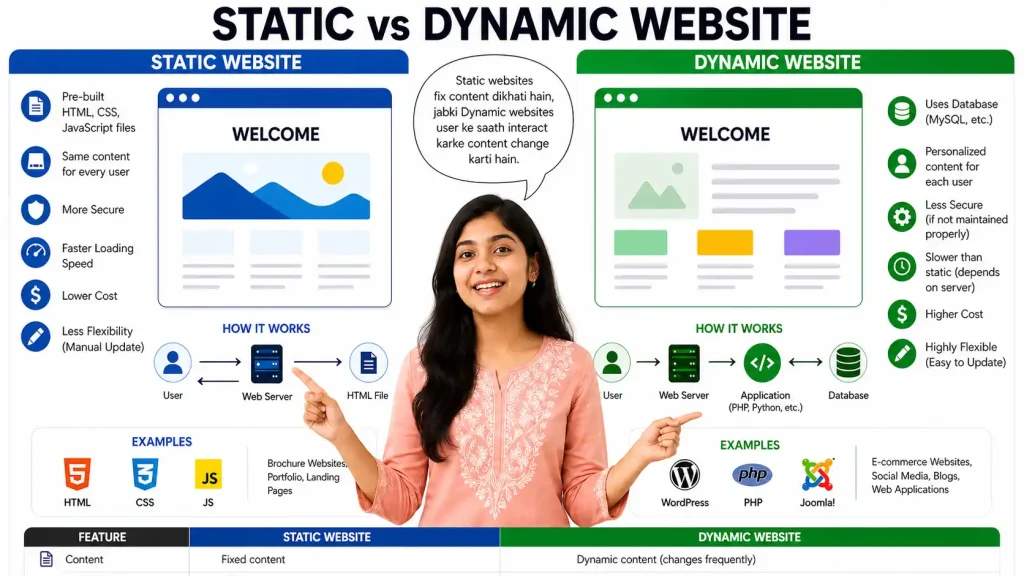
Difference between static and dynamic website is one of the most important decisions when creating a website for your business. Choosing the wrong type can affect your website performance, SEO ranking, and lead generation. In this guide, we will explain the difference between static and dynamic website in simple terms so you can choose the best option.
- Understanding the difference between static and dynamic website helps businesses make better decisions.
- The main difference between static and dynamic website is how content is managed.
- Before choosing, you must clearly know the difference between static and dynamic website for long-term growth.
What is a Static Website?
A static website is a basic website where content remains fixed.
Every page is pre-designed and doesn’t change unless manually updated.
Example:
- Business profile websites
- Portfolio websites
- Simple landing pages
What is a Dynamic Website?
A dynamic website is interactive and can display different content based on user actions.
Content updates automatically using a database.
Example:
- E-commerce websites
- Blogs
- Booking platforms
- Social media platforms
Static vs Dynamic Website (Key Differences)
| Feature | Static Website | Dynamic Website |
|---|---|---|
| Content | Fixed | Changeable |
| Speed | Very Fast | Slightly Slower |
| Cost | Low | Higher |
| Maintenance | Easy | Moderate |
| Functionality | Limited | Advanced |
| SEO | Basic | Strong SEO Potential |
| User Interaction | No | Yes |
Advantages of Static Website
- Fast loading speed
- Low cost
- Simple to build
- High security (less hacking risk)
Disadvantages:
- No advanced features
- Hard to update content frequently
- Not suitable for growing businesses
Advantages of Dynamic Website
- Easy to update content
- Advanced features (forms, login, chatbot)
- Better for SEO & ranking
- Great for lead generation
Disadvantages:
- Higher cost
- Requires maintenance
- Slightly slower than static
Which Website is Better for Your Business?
Choose Static Website if:
- You need a basic online presence
- Your budget is low
- No frequent updates required
Choose Dynamic Website if:
- You want leads & conversions
- You plan to scale your business
- You need SEO & marketing
- You want features like forms, WhatsApp, chatbot
Which Website is Better for Your Business?
- In 2026, most businesses should go for:
Dynamic Website
Because:
- Google prefers updated content
- Users expect interaction
- Businesses need lead generation
A static website is like a digital brochure
A dynamic website is like a sales machine
How This Impacts Your Business Growth
Wrong choice = No leads
Right choice = More conversions
A dynamic website helps you:
- Capture leads
- Rank on Google
- Build trust
- Automate marketing
FAQs
Q1. Is static website good for SEO?
It has limited SEO capabilities compared to dynamic websites.
Q2. Is dynamic website expensive?
Yes, but it gives better ROI in the long run.
Q3. Which website is best for small business?
Dynamic website is best for growth and lead generation.
Q4. Can a static website become dynamic?
Yes, but it requires redevelopment.
Conclusion
Choosing the right website type can decide your business success online.
If you want growth, leads, and scalability, a dynamic website is the best choice.
Need Help?
If you’re planning to build a high-converting website,
Onetech Solution can help you create a powerful business website that generates leads.