





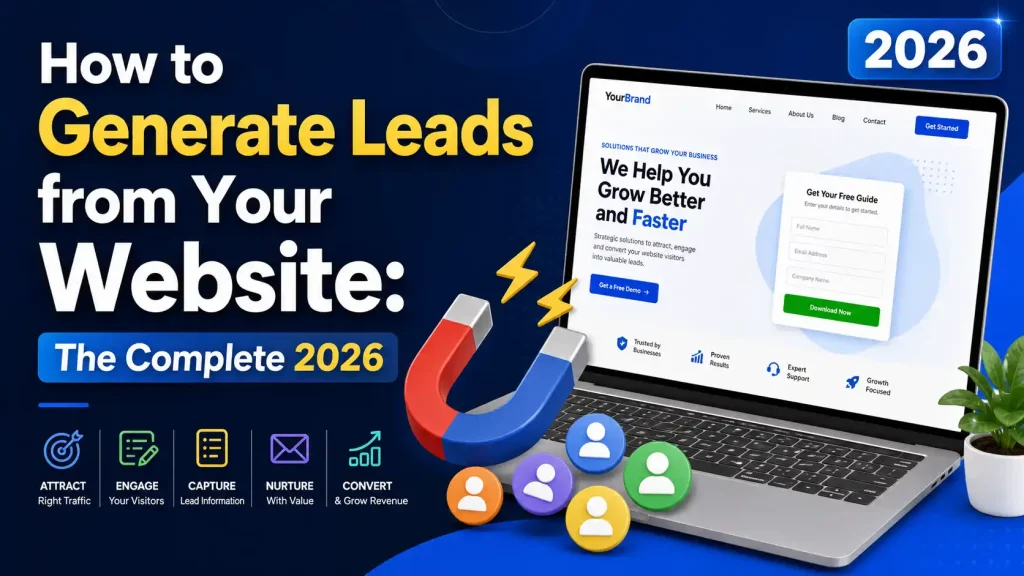
How to Generate Leads from Your Website: The Complete 2026 .
Introduction
Why Most Websites Are Digital Ghost Towns
In the modern digital economy, having a website is no longer a competitive advantage; it is a basic prerequisite. However, there is a massive disconnect between having a website and having a website that actually works for your business. Millions of businesses pour their marketing budgets into driving traffic, only to watch those visitors bounce away, never to return. They treat their websites like static digital brochures rather than dynamic, 24/7 sales machines.
If you are reading this, you are likely facing a common and frustrating challenge: your traffic metrics might look acceptable, but your inbox is empty. The phone isn’t ringing. The contact forms are gathering dust. You are left wondering, how to generate leads from your website effectively, consistently, and predictably?
The truth is, getting traffic is only 20% of the battle. The remaining 80% relies entirely on your ability to capture that traffic, engage it, and convert it into qualified leads. A lead is not just a random email address; it is a potential customer who has raised their hand and shown genuine interest in your solution.
In this comprehensive, definitive guide, we will break down the exact architecture of a high-converting website. We will move past surface-level advice and dive deep into UI/UX psychology, problem-centric SEO, advanced conversational automation, and high-value lead magnets. Whether you are running a service-based agency, a large-scale corporate enterprise, or an emerging e-commerce brand, this blueprint will transform your digital presence from a leaky bucket into an automated lead generation engine.
The Anatomy of a High-Converting Website
Before we implement advanced marketing tactics, we must ensure the foundation is solid. A website built on poor user experience will never convert, regardless of how much traffic you send to it. Lead generation starts with web design.
1.1 The Psychology of UI/UX Design
User Interface (UI) and User Experience (UX) dictate how a visitor feels when they land on your site. In a world of decreasing attention spans, you have approximately 3 to 5 seconds to convince a user to stay.
Embrace Minimalist & Modern Aesthetics: Cluttered websites create cognitive overload. Modern design trends, such as glassmorphism (frosted glass effects) combined with minimalist layouts, allow users to focus entirely on your value proposition. By using ample white space (negative space), you guide the user’s eye naturally down the page.
Strategic Use of Color: Do not underestimate the power of color psychology. If your primary brand colors are muted and professional, use contrasting colors for your conversion elements. A subtle neon glow effect on a primary “Get a Quote” button against a dark, minimalist background can increase click-through rates significantly.
Visual Hierarchy: The most important information should be the most prominent. Use clear H1, H2, and H3 tags. Break text into small, digestible paragraphs. If a user is intimidated by a massive wall of text, they will leave.
1.2 Speed is the Ultimate Conversion Killer
You cannot generate leads if your website takes too long to load. According to Google’s Core Web Vitals research, a one-second delay in page load time can drop your conversion rate by up to 7%.
Optimize Media Assets: Compress all images using next-gen formats like WebP. If you are using heavy background videos, ensure they are optimized and do not block the main thread from loading.
Minify Code: Ensure your CSS, JavaScript, and HTML are minified to reduce server response times.
Leverage Caching: Use advanced caching plugins and a robust Content Delivery Network (CDN) to serve your website rapidly to users, regardless of their geographical location.
1.3 Mobile-First Optimization
Over 60% of global web traffic originates from mobile devices. If your website is merely “mobile-responsive” but not “mobile-first,” you are losing leads. Your lead capture forms must be easy to tap with a thumb. Text must be legible without zooming. Navigation menus must be intuitive and frictionless on a small screen.
The Art of the Irresistible Lead Magnet
A fundamental rule of website lead generation is the principle of equivalent exchange. A visitor will not give you their personal information (name, email, or phone number) for free. You must offer something of equal or greater perceived value in return. This is your Lead Magnet.
2.1 Why "Subscribe to Our Newsletter" is Dead
“Subscribe to our newsletter for updates” is the weakest call-to-action on the internet. Nobody wakes up wanting more generic emails in their inbox. To capture a high-quality lead, your offer must solve a specific, immediate problem for your target audience.
2.2 Formulating High-Value Lead Magnets
The best lead magnets are highly actionable, easy to consume, and directly related to your core service.
The “Done-For-You” Templates & Toolkits: Professionals love shortcuts. If you run a marketing agency, offering a free “WhatsApp Automation Script Template” or a “Social Media Content Calendar” provides instant value. The user downloads the template, sees your expertise, and is now primed for a sales conversation.
Industry-Specific Blueprints: Tailor your magnets to your niche. If you are targeting B2B companies, a comprehensive PDF on “How to Set Up a Secure Freight Forwarding Supply Chain” will attract high-ticket logistics leads.
Free Consultations & Audits: Offer a complimentary, 15-minute discovery call or a free technical SEO audit. This establishes immense trust and positions you as an expert consultant rather than a pushy salesperson.
Interactive Calculators and Quizzes: People love interactive content. A “Calculate Your Solar ROI” tool for a renewable energy company provides customized value while capturing lead data in the background.
2.3 Gating Your Content Strategically
Not all content should be gated (hidden behind a form). Your educational blog posts and top-of-funnel content should be freely accessible to build SEO authority. However, your high-value, bottom-of-funnel resources—like proprietary research reports or advanced toolkits—should always be gated to capture lead information.
Problem-Centric SEO Content Strategy
If you want to know how to generate leads from your website organically, you must master SEO. However, traditional keyword stuffing is obsolete. Today, Google rewards “Helpful Content” that directly answers the searcher’s intent.
3.1 The Shift to Problem-Centric Content
Most companies focus their SEO on their own services (e.g., targeting the keyword “Best Web Development Agency”). The problem is, these keywords are fiercely competitive, and the searcher might not be ready to buy yet.
Instead, focus on the problems your potential clients are searching for. For example:
Instead of “Buy CRM software,” target “How to organize client data for a small business.”
Instead of “Corporate Web Design,” target “Why is my business website bounce rate so high?”
By answering their questions in a comprehensive, 2000+ word blog post, you build trust. You become the helpful guide. When they are finally ready to hire someone to solve the problem, you are the obvious choice.
3.2 On-Page Optimization Fundamentals
To ensure your problem-centric content ranks, you must follow strict on-page SEO protocols. Using tools like RankMath can help you systematize this process.
Title Tags and Meta Descriptions: Your title tag must include your focus keyword and a compelling hook. Your meta description (150-160 characters) should act as ad copy, enticing the user to click from the SERP (Search Engine Results Page).
Header Tags (H1, H2, H3): Structure your content logically. The H1 is your main title. H2s are your main sections. H3s are subsections. Include Latent Semantic Indexing (LSI) keywords—contextually related terms—in your H2s and H3s.
Internal Linking Architecture: Never leave a blog post as an isolated island. Every piece of content should have at least 3-4 internal links pointing to your core service pages or relevant lead magnet landing pages. This spreads “link equity” and guides the user deeper into your funnel.
Image Optimization: Search engines cannot “read” images. You must add descriptive Alt Text to every image, including your focus keywords naturally where appropriate.
Advanced Conversational Marketing & Automation
We live in an era of instant gratification. If a high-value B2B prospect lands on your website and has a burning question, asking them to fill out a 10-field contact form and wait 24-48 hours for an email response is a surefire way to lose them to a competitor.
This is where advanced conversational marketing completely revolutionizes how to generate leads from your website.
4.1 The Power of WhatsApp API Integration
While traditional live chat widgets are helpful, they have a fatal flaw: if the user closes the browser window before you reply, the lead is lost forever. Integrating a WhatsApp Business API directly into your website solves this problem instantly.
When a user clicks the WhatsApp widget on your site:
They are redirected to their most trusted, frequently used messaging app.
The moment they send the first pre-filled message (e.g., “Hi, I want to know more about your services”), you instantly capture their verified phone number.
Even if they close your website, the conversation remains active on their phone.
4.2 Building Intelligent Bot Workflows
You do not need to be awake 24/7 to generate leads. By building automated workflows, your bot can qualify leads while you sleep.
Routing and Triage: Set up a menu system. “Press 1 for Sales, Press 2 for Support, Press 3 to Download our Pricing Guide.”
Lead Qualification: The bot can ask qualifying questions: “What is your monthly marketing budget?” or “Are you looking for a B2B or B2C solution?” Based on their answers, the bot can route high-ticket leads directly to your sales team’s WhatsApp numbers, while nurturing lower-tier leads with automated PDF downloads.
The Follow-Up Sequence: WhatsApp API allows for strategic template messages. If a user downloaded a template yesterday, the system can automatically send a follow-up message today: “Hi! Did you find the template useful? Let us know if you need help implementing it.” This level of personalized, frictionless follow-up skyrockets conversion rates.
Designing High-Converting Landing Pages
A landing page is a standalone web page created specifically for a marketing or advertising campaign. It is where a visitor “lands” after they click on an ad, an email link, or a social media post. Unlike your homepage, which encourages exploration, a landing page has one single objective: Lead Capture.
5.1 The Rule of One
The biggest mistake marketers make is putting multiple offers on a single landing page. A landing page must follow the “Rule of One”: One target audience, one core message, and one Call to Action (CTA). Remove the top navigation menu and footer links. The user should only have two choices: convert, or close the tab.
5.2 Anatomy of a Perfect Landing Page
To maximize lead generation, structure your landing pages with these essential elements:
The Headline: This is the most critical element. It must perfectly match the ad or link that brought the user there. If the ad promised “Free E-Commerce Growth Strategies,” the headline must explicitly state exactly that.
The Hero Section: Use a high-quality image or, better yet, a short video explaining the value of the offer. Video can increase conversion rates by up to 80%.
Benefit-Driven Copy: Do not list features; list benefits. Do not say “Includes 10 spreadsheet tabs.” Say “Save 15 hours a week with our automated tracking system.”
Social Proof: Trust is the currency of the internet. Embed case studies, client logos, video testimonials, and trust badges (like ISO 9001:2015 certifications) directly next to the lead capture form.
The Frictionless Form: Only ask for the information you absolutely need. Every additional field you add to a form reduces the conversion rate. For a top-of-funnel eBook, ask for an email. For a high-ticket B2B service inquiry, ask for Name, Company, and Phone/WhatsApp number.
Tailoring Strategies for Different Industries
The core principles of lead generation remain the same, but the execution varies wildly depending on your niche. Understanding these nuances is key to maximizing your website’s potential.
6.1 B2B Corporate Lead Generation (E.g., Renewable Energy, Logistics)
For high-ticket, long-sales-cycle B2B clients (like a joint venture in the green energy sector or a massive freight forwarding company), trust and authority are paramount.
The Strategy: These audiences do not impulse-buy. Your website must act as a thought leadership hub. Generate leads by offering incredibly deep, data-rich whitepapers, comprehensive case studies showcasing massive ROI, and invitations to exclusive industry webinars.
The CTA: Instead of “Buy Now,” use “Request a Custom Proposal” or “Speak to a Strategy Consultant.” B2B buyers want to know they are dealing with established experts. Ensure your “About Us” page prominently displays your company history, founding year, and leadership team.
6.2 B2C E-Commerce Lead Generation (E.g., Apparel Brands)
For business-to-consumer platforms, such as a kids’ clothing brand, the sales cycle is fast, highly visual, and emotionally driven.
The Strategy: The primary goal is capturing the email or WhatsApp number before they abandon their cart. Use visually stunning popup forms offering a direct financial incentive, such as “Spin the Wheel for 15% Off Your First Order” or “Unlock Free Shipping.”
The CTA: E-commerce relies on urgency and immediate gratification. Use CTAs like “Claim My Discount,” “Shop the New Collection,” or “Add to Bag.” Retargeting via abandoned cart emails or automated WhatsApp reminders is critical for B2C lead recovery.
Tracking, Analytics, and Continuous Optimization
You cannot improve what you do not measure. Setting up a lead generation system is only phase one; phase two is relentless optimization based on hard data.
7.1 Essential Tracking Tools
Google Analytics 4 (GA4): Set up custom conversion events. Track exactly how many people land on your form page, how many start filling it out, and how many actually hit submit.
Heatmaps and Session Recording: Tools like Microsoft Clarity or Hotjar are invaluable. They record user sessions anonymously, allowing you to see exactly where users are moving their mouse, how far they scroll, and where they get frustrated and leave (rage-clicking).
UTM Parameters: Always use UTM tags on your links in social media or email campaigns. This tells your analytics dashboard exactly which specific post or email generated the lead, allowing you to double down on what works.
7.2 The Philosophy of A/B Testing
Never rely on gut feeling when it comes to conversion rate optimization. Always run A/B split tests.
- Test a short, punchy headline against a long, descriptive one.
- Test a red CTA button against a green one.
- Test a landing page with a video versus one with only text and images. Change only one variable at a time so you know exactly what caused the increase or decrease in conversions. Over months of consistent testing, you will incrementally increase your website’s lead generation capabilities to their absolute maximum potential.
Conclusion:
Learning how to generate leads from your website is the most profitable skill a business owner or marketer can master. Your website is an investment. It is an employee that never sleeps, never takes a day off, and has the potential to pitch your services to thousands of people simultaneously.
However, it will only perform if you give it the right tools and strategies. By auditing your current UI/UX, shifting to a problem-centric SEO content strategy, crafting irresistible lead magnets, and supercharging your response times with WhatsApp automation, you will stop the leaks in your digital funnel.
Stop settling for vanity metrics like “page views” and “impressions.” Focus on the metrics that actually impact your bottom line: captured leads, booked meetings, and closed deals. Implement this blueprint systematically, test your results, and watch your website transform into a relentless, high-performing lead generation engine.
Frequently Asked Questions (FAQs)
Q1: My website gets thousands of visitors a month, but zero leads. What is the first thing I should check?
A: Check your user intent and your CTA visibility. If your traffic is coming from a broad, informational blog post but you are immediately asking them to “Buy Now,” there is a massive intent mismatch. Give them a soft-step lead magnet (like a checklist) first. Also, use heatmaps to see if users are even scrolling down far enough to see your contact forms.
Q2: How effective is SEO for immediate lead generation?
A: SEO is a marathon, not a sprint. It is a long-term asset. If you need leads today, you must use performance marketing (Google Search Ads or Meta Ads) directed to highly optimized landing pages. Use ads for immediate cash flow, and build your SEO architecture in the background for long-term, free organic leads.
Q3: Can I generate leads without offering a free download or discount?
A: Yes, but it is much harder. If you do not offer a “lead magnet,” your only conversion mechanism is “Contact Us.” This means you will only capture the 1-2% of users who are ready to buy right now. You will miss out on the 98% of users who are interested but still in the research phase.
Q4: Does website speed really impact lead generation that much?
A: Absolutely. Mobile users, in particular, have zero patience. If your page takes 5 seconds to load, over 40% of your visitors will hit the back button before seeing a single word of your copy. Faster sites index better on Google and convert higher. Optimize your site speed relentlessly.
Q5: Should I use a chatbot or a simple contact form?
A: The best approach is a hybrid one. Have a short, optimized contact form on your dedicated landing pages for users who prefer traditional communication. Simultaneously, implement a conversational WhatsApp or AI bot in the corner of your site to engage users who want instant answers. Giving users the power to choose their preferred communication method increases overall conversion rates.
Stop Losing Clients to Your Competitors Today.
📞 Call us: +91 966-988-5053 | +91 8770-70-3080 📧 Email: info@onetechsolution.in 🌐 Visit: https://onetechsolution.in
ou know the strategies, but executing them takes time, precision, and technical expertise. Let us turn your digital presence into a 24/7 lead-generating machine.