














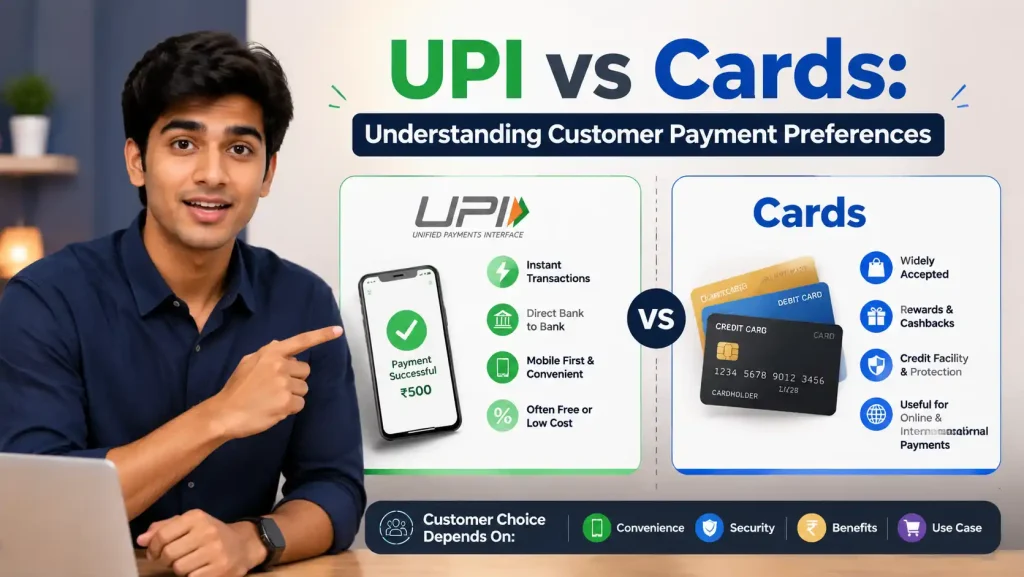
UPI vs Cards: Understanding Customer Payment Preferences in 2026
Introduction
The digital payment landscape in India has transformed dramatically over the past decade. With the introduction of Unified Payments Interface (UPI) and the evolution of card-based payments, consumers now have multiple options to complete transactions seamlessly. But which payment method do customers actually prefer, and why does it matter for your business?
In this comprehensive guide, we’ll dive deep into the UPI vs Cards debate, analyzing customer preferences, transaction data, security aspects, and business implications. Whether you’re a merchant looking to optimize payment options or a consumer curious about the best payment method, this article covers everything you need to know.
What is UPI? A Quick Overview
Unified Payments Interface (UPI) is a real-time payment system developed by the National Payments Corporation of India (NPCI). Launched in 2016, UPI has revolutionized how Indians transfer money and make payments.
Key Features of UPI:
- Instant transfers between bank accounts
- Single mobile application for multiple bank accounts
- Virtual Payment Address (VPA) eliminates need to share bank details
- 24/7 availability for transactions
- Zero or minimal transaction fees for consumers
- QR code scanning for quick payments
Popular UPI Apps:
- Google Pay
- PhonePe
- Paytm
- BHIM
- Amazon Pay
- WhatsApp Pay
Understanding Card Payments: Debit and Credit Cards
Card payments have been the backbone of digital transactions globally for decades. In India, both debit and credit cards continue to play a significant role in the payment ecosystem.
Types of Card Payments:
1. Debit Cards
- Linked directly to bank accounts
- Transactions deducted immediately
- No credit facility involved
- Ideal for budget-conscious spending
2. Credit Cards
- Provides credit limit from issuer
- Pay later option (billing cycle)
- Rewards, cashback, and benefits
- Helps build credit score
Card Payment Methods:
- Chip and PIN – Secure in-person transactions
- Contactless NFC – Tap-and-pay technology
- Online card payments – E-commerce transactions
- Card-on-file – Saved for recurring payments
UPI vs Cards: Direct Comparison
Let’s break down the key differences between UPI and card payments across various parameters:
1. Transaction Speed
UPI: Near-instantaneous transfers, typically completing within seconds. No waiting period for payment confirmation.
Cards: Credit card transactions process quickly but settlement to merchants can take 2-3 days. Debit card transactions are faster but still involve processing time.
Winner: UPI for speed
2. Transaction Costs
UPI: Free for consumers in most cases. Merchants pay minimal MDR (Merchant Discount Rate) or zero MDR for smaller transactions.
Cards: Merchants typically pay 1-3% MDR. Consumers may face annual fees, foreign transaction fees, and late payment charges (credit cards).
Winner: UPI for cost-effectiveness
3. Security Features
UPI:
- Two-factor authentication (UPI PIN + device authentication)
- No sharing of bank account details
- Transaction limits to minimize fraud risk
- End-to-end encryption
Cards:
- EMV chip technology
- CVV verification for online transactions
- OTP authentication for added security
- Chargeback protection for disputed transactions
Winner: Tie – Both offer robust security with different mechanisms
4. Ease of Use
UPI:
- Simple interface requiring just a UPI PIN
- QR code scanning for quick payments
- No need to carry physical cards
- Works offline with *99# USSD service
Cards:
- Requires physical card or saved details
- Multiple fields to enter for online payments
- Contactless option simplifies in-person payments
- Widely accepted internationally
Winner: UPI for domestic convenience, Cards for international use
5. Acceptance and Reach
UPI:
- Massive adoption across India
- 500+ million users (as of 2026)
- Limited international acceptance
- Ideal for P2P and small merchant transactions
Cards:
- Global acceptance across millions of merchants
- Essential for international travel and purchases
- Established infrastructure for decades
- Premium merchants prefer card payments
Winner: Cards for global reach, UPI for Indian market penetration
6. Rewards and Benefits
UPI:
- Limited cashback offers from apps
- Occasional promotional rewards
- Mostly transaction-focused, not reward-focused
Cards:
- Extensive rewards programs
- Cashback on categories (fuel, dining, shopping)
- Airport lounge access (premium cards)
- EMI conversion options
- Travel and insurance benefits
Winner: Cards for rewards and benefits
7. Transaction Limits
UPI:
- ₹1 lakh per transaction (for most transactions)
- ₹2 lakh for specific categories (healthcare, education)
- Daily limits vary by bank
Cards:
- Credit limit depends on card issuer
- Higher limits for premium cards
- International transaction limits can be adjusted
Winner: Cards for high-value transactions
Customer Payment Preferences: What the Data Shows
UPI Transaction Statistics (2025-2026)
- 12.5 billion+ transactions per month (as of early 2026)
- ₹20 trillion+ monthly transaction value
- 93% year-over-year growth in merchant transactions
- 65% of digital payments in India are UPI-based
Card Payment Statistics (2025-2026)
Reserve Bank of India reports:
- 1.2 billion+ card transactions per month
- ₹1.5 trillion monthly transaction value
- Credit cards growing at 18% annually
- Debit card usage declining as UPI grows
Customer Preference Trends
Recent surveys reveal:
For Small Transactions (Under ₹500):
- 78% prefer UPI
- 15% prefer cards
- 7% prefer cash
For Medium Transactions (₹500-₹5,000):
- 62% prefer UPI
- 32% prefer cards
- 6% prefer other methods
For Large Transactions (Above ₹5,000):
- 45% prefer cards
- 40% prefer UPI
- 15% prefer net banking/other
For Online Shopping:
- 58% prefer UPI
- 35% prefer cards
- 7% prefer COD/wallets
Demographic Insights:
Age 18-35:
- Strong preference for UPI (72%)
- Use cards primarily for rewards and international purchases
Age 36-50:
- Balanced usage – 55% UPI, 40% cards
- Appreciate both convenience and rewards
Age 50+:
- 48% cards, 35% UPI, 17% traditional methods
- Trust established payment methods
Why Do Customers Prefer UPI?
1. Zero Transaction Fees
Consumers don’t pay anything for UPI transactions, making it attractive for frequent small payments.
2. Simplicity
Just scan a QR code, enter UPI PIN, and you’re done. No card details, no CVV, no hassle.
3. No Need for Physical Card
Everything happens through smartphones. Lost card? Not a problem with UPI.
4. Instant Settlements
Money reaches the recipient immediately, perfect for P2P transactions.
5. Wide Merchant Acceptance
From street vendors to large retailers, UPI QR codes are everywhere in India.
6. Bank Account Integration
Direct bank-to-bank transfers without intermediaries.
Why Do Customers Still Use Cards?
1. International Acceptance
UPI doesn’t work outside India (yet). Cards are essential for foreign transactions.
2. Rewards and Cashback
Credit cards offer substantial rewards that can offset annual fees and provide real value.
3. Credit Facility
Buy now, pay later – essential for managing cash flow and large purchases.
4. Premium Services
Lounge access, concierge services, insurance coverage come with premium cards.
5. Purchase Protection
Chargeback rights protect consumers from fraudulent merchants.
6. Higher Transaction Limits
Cards support larger transactions without daily limits.
7. Established Trust
Decades of use have built consumer confidence in card security.
Business Perspective: Which Should You Accept?
For Small Businesses and Startups
Recommend: UPI Primary, Cards Secondary
Reasons:
- Lower transaction costs
- Faster settlements
- Easier integration
- Customers prefer UPI for small amounts
For E-commerce Platforms
Recommend: Both Equally Important
Reasons:
- Diverse customer base with different preferences
- Cards offer EMI options for high-value purchases
- UPI captures the cost-conscious segment
- International customers need card options
For Premium Businesses (Luxury Retail, Hotels)
Recommend: Cards Primary, UPI Secondary
Reasons:
- High-value transactions exceed UPI limits
- International clientele
- Customers expect premium payment experience
- Chargeback protection for expensive items
For Recurring Subscriptions
Recommend: Cards (with UPI AutoPay as alternative)
Reasons:
- Auto-debit functionality well-established
- UPI AutoPay still gaining adoption
- Better failure management with cards
- International subscribers need cards
Security Comparison: Which is Safer?
Both payment methods are secure when used correctly. Here’s what you need to know:
UPI Security Best Practices:
- Never share UPI PIN with anyone
- Verify merchant details before paying
- Use app lock and device security
- Check transaction history regularly
- Report suspicious activity immediately
Card Security Best Practices:
- Never share CVV or OTP
- Use virtual cards for online shopping
- Enable transaction alerts
- Monitor credit card statements
- Report lost/stolen cards immediately
- Avoid saving cards on unsecured websites
Common Scams to Watch Out For:
UPI Scams:
- Fake customer care calls asking for UPI PIN
- QR code scams (receiving money instead of sending)
- Phishing links via SMS
Card Scams:
- Skimming devices at ATMs
- Phishing emails requesting card details
- Fake merchant websites
Verdict: Both are equally secure if users follow best practices. The weakest link is usually user awareness.
The Future: UPI vs Cards in 2026 and Beyond
UPI's Growth Trajectory
- International expansion: UPI now accepted in UAE, Singapore, and expanding to more countries
- Credit line on UPI: RBI-approved credit access through UPI
- Conversational payments: Voice-enabled UPI transactions
- Offline UPI: Near Field Communication (NFC) based offline payments
- RuPay credit cards on UPI: Blurring lines between UPI and cards
Card Innovations
- Virtual cards: Instant card generation for online safety
- Biometric authentication: Fingerprint-enabled card payments
- Cryptocurrency-linked cards: Bridge between crypto and fiat
- Enhanced rewards: AI-driven personalized offers
- Sustainability: Eco-friendly card materials
The Hybrid Future
The future isn’t UPI vs Cards—it’s UPI AND Cards working together:
- Tokenization: Secure card storage in UPI apps
- Unified interfaces: Pay with any method through one app
- Interoperability: Seamless switching between payment modes
- Smart routing: Automatic selection of best payment method
Frequently Asked Questions (FAQs)
Q1: Is UPI safer than debit cards?
Ans :- Both UPI and debit cards are secure payment methods. UPI uses two-factor authentication (device + UPI PIN), while cards use chip technology and OTP verification. Security depends more on user practices than the payment method itself.
Q2: Can I use UPI for international payments?
Ans :- As of 2026, UPI is accepted in select countries including UAE, Singapore, Bhutan, and Nepal. However, for most international transactions, credit or debit cards remain the primary option.
Q3: Which payment method is cheaper for merchants?
Ans :- UPI typically has lower merchant discount rates (MDR) compared to cards. Small merchants often pay zero MDR on UPI, while card payments can cost 1-3% per transaction.
Q4: Do I get rewards on UPI payments?
Ans :- UPI payments generally don’t offer structured reward programs like credit cards. However, UPI apps occasionally provide cashback offers and promotional rewards.
Q5: What is the maximum amount I can transfer via UPI?
Ans :- The standard UPI transaction limit is ₹1 lakh per transaction. For specific categories like healthcare and education, the limit is ₹2 lakh. Daily limits vary by bank.
Q6: Why should I use a credit card instead of UPI?
Ans :- Credit cards are ideal for: international purchases, earning rewards and cashback, accessing credit for large purchases, getting premium benefits like lounge access, and transactions exceeding UPI limits.
Q7: Can UPI replace cards completely?
Ans :- Not in the near future. While UPI dominates domestic small-value transactions, cards remain essential for international use, high-value purchases, credit facilities, and premium rewards programs.
Q8: Which is faster - UPI or card payment?
Ans :- UPI payments are generally faster, completing within seconds. Card payments also process quickly, but merchant settlement can take 2-3 days compared to instant settlement with UPI.
Conclusion: The Verdict on UPI vs Cards
There’s no absolute winner in the UPI vs Cards debate—the best payment method depends on your specific needs:
Choose UPI when:
- Making domestic transactions
- Paying small to medium amounts
- You want zero transaction fees
- Speed and convenience are priorities
- Paying individuals or small merchants
Choose Cards when:
- Making international purchases
- You want rewards and cashback
- You need credit facility
- Making high-value transactions above ₹1 lakh
- You value purchase protection and chargebacks
The Smart Approach: Use both payment methods strategically. Keep UPI as your primary method for everyday domestic transactions, and maintain a good credit card for rewards, international use, and high-value purchases. This hybrid approach maximizes benefits while minimizing costs.
As India’s digital payment ecosystem evolves, we’re moving toward a future where payment methods complement rather than compete with each other. The key is understanding when to use which method to make the most of your money.
Ready to Integrate Multiple Payment Options on Your Website in 2026?
At Onetech Solution, we specialize in creating modern, high-converting e-commerce websites with seamless payment gateway integration. Our expert team will help you dominate the Indian digital payment landscape by:
✅ Integrating all major payment options (UPI, Cards, Net Banking, Wallets) for maximum conversions
✅ Implementing secure payment gateways with PCI-DSS compliance and fraud protection
✅ Optimizing checkout experience that reduces cart abandonment by up to 35%
✅ Building mobile-first payment interfaces that load in under 2 seconds
✅ Setting up analytics & tracking to understand customer payment preferences
✅ Ensuring your website ranks higher with Google’s mobile-first indexing and Core Web Vitals
Get a Free Payment Gateway Integration Consultation Today!
📞 Call us: +91 966-988-5053 | +91 8770-70-3080
📧 Email: info@onetechsolution.in
🌐 Visit: https://onetechsolution.in
Located in Indore: EE42, Super City, Near Gyanshila Square, Dhabali, Indore (M.P.)
Don’t let complicated payment systems hold your business back. Contact Onetech Solution today and turn your website into a modern, high-performance, multi-payment conversion machine that accepts UPI, cards, and all popular payment methods seamlessly!